
Why I Don’t Think of Bilt as a Housing Card Anymore
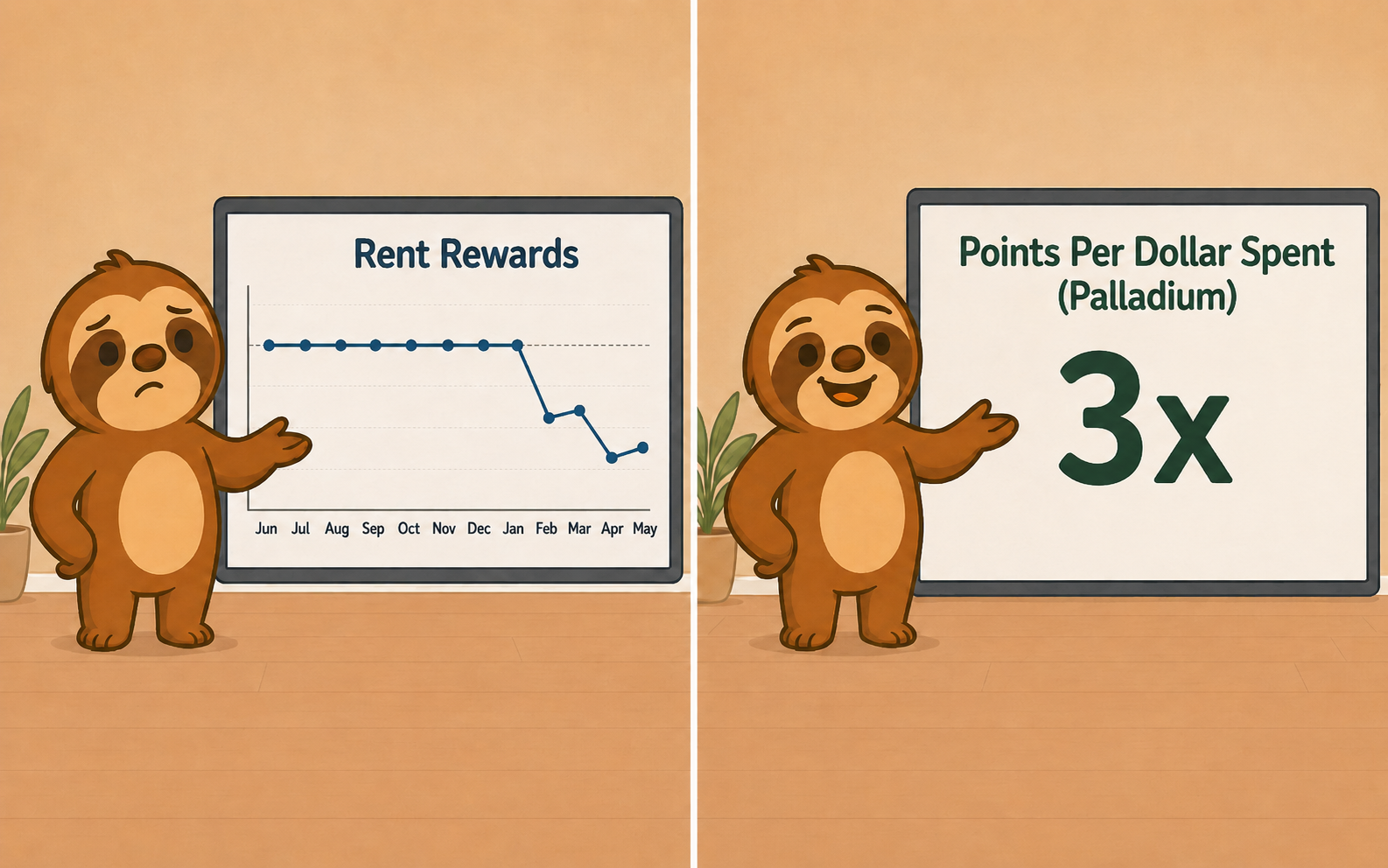
(Rewards rates purely illustrative.)
Tl;dr: Bilt used to straightforwardly reward rent payments, but Bilt 2.0 uses rent as a convoluted mechanism to reward overall spending. To fully optimize housing payments, it may be better to involve another card like the Atmos Summit in your overall strategy.
Once upon a time, if you had a Bilt card, you could basically earn one Bilt point for each dollar of rent, with no fees. In Bilt 2.0, cards still revolve around housing, and Bilt still markets them that way. But the real value now depends less on your housing payment itself and more on how much everyday spending you put on the card. That means the best way to analyze Bilt may not be “how many points do I earn on rent?” but “what return am I getting on my credit card purchases?”
Bilt Housing Rewards Aren’t Proportional to Housing Costs
Trying to think about Bilt rewards this way—as points on housing—makes the program feel confusing and unpredictable.
Bilt used to straightforwardly offer points on rent payments—as long as you used your card five times each month, you would get a point for each dollar of rent paid through Bilt, up to a very generous cap. That model proved unsustainable, though, and led to Bilt 2.0.
Bilt still heavily advertises “the richest rewards on rent [and] mortgage.” Bilt had established a reputation for rewarding rent, then announced big plans to reward mortgage payments similarly. As a result, many people still think of Bilt as a card to earn rewards on housing. And that’s not entirely wrong. But now it’s… complicated. And, more importantly, it’s entirely tied to card spending.
You can choose “simple, fee-free housing rewards” to earn a set number of points based on your housing payments, but the level of rewards fluctuates based on the ratio of card spending to housing payments. 😵💫
You can also choose to redeem Bilt Cash (each card earns 4% Bilt Cash per dollar spent) for points on housing. You can use our LazyPoints calculators to see how much you’d need to spend to get points on all your housing payments, or to see how much housing bonus points you could get from a certain card spending level.
But, as with the “simple” rewards, the value you unlock depends less on your housing payment itself than on how much ordinary spending you put on the card. Spend enough, and you’ll max out housing points and have leftover Bilt Cash instead of points (not necessarily a bad thing!). Or, with lower spending, you might not get points on your entire housing costs.
So trying to think in terms of how many points you will get for your rent probably won’t deliver a straightforward or consistent answer.
How Bilt 2.0 Rewards Spending—Handsomely
Much more straightforward—though not exactly simple—is Bilt’s rewards on spending. In addition to base points earning, the Bilt cards earn 4% Bilt Cash on each dollar spent. When assessing the Bilt cards, I find it easier to simply compare that earning rate to other cards.
As a reminder, here are the earning rates per dollar spent for each Bilt Card (Bilt Cash applies if you choose that option over “simple” rewards):
| Card | Dining / Groceries | Travel | All Other | Bilt Cash |
|---|---|---|---|---|
| Blue | 1x | 1x | 1x | 4% |
| Obsidian | 3x | 2x | 1x | 4% |
| Palladium | 2x | 2x | 2x | 4% |
Bilt offers three different ways to turn card spending into roughly one extra Bilt point per dollar— and in some cases more:
Use Bilt Cash to activate the “Point Accelerator” (Obsidian and Palladium only) on up to $25,000 in card spending
Choose “simple” rewards and spend between 25% and 125% of your monthly housing payment on the card
Use Bilt Cash for housing rewards and spend up to 100% of your monthly housing payment
Now, that’s a simplified breakdown. Each of those could warrant their own post to deal with all the nuances and complications and comparisons. The main thing is that earning an extra point for each dollar of spending is quite doable.
And if you earn at least one extra Bilt point per dollar, you could effectively earn at these rates:
| Card | Dining / Groceries | Travel | All Other |
|---|---|---|---|
| Blue | 2x | 2x | 2x |
| Obsidian | 4x | 3x | 2x |
| Palladium | 3x | 3x | 3x |
Thinking of it this way, Bilt cards don’t earn “points on housing,” but these earning rates on card spending would be among the best in the industry.
Notably, the Point Accelerator and housing rewards aren’t even the best ways to redeem Bilt cash. So while I like to use the ability to earn an extra Bilt Point per dollar as my reference point when comparing a Bilt card to the competition, the reality might actually be even better for some users.
How a Non-Bilt Card Can Help
The grand irony of Bilt 2.0 is that if you want to maximize Bilt points per dollar spent, you may want to limit your Bilt spending.
Through the Point Accelerator and/or housing rewards, it’s possible to earn an extra Bilt point or so per dollar spent—up to a point. The Point Accelerator can only be used on up to $25,000 in annual (calendar year) spend. And for housing rewards, once you maximize your points on housing, you will either earn no further rewards (with “simple” rewards) or earn only Bilt Cash.
That might be fine—housing rewards aren’t even the most rewarding Bilt Cash redemption—but if you want to make sure you earn that extra Bilt point per dollar, it can be pretty straightforward to do so. By also spending on another card, you can ensure that you don’t overspend on Bilt.
The most obvious candidate is the Atmos Summit. If you regularly transfer Bilt points to Atmos like I do, you could use the Summit to earn 3x Atmos points on dining and foreign purchases, while earning with Bilt on other purchases.
If you prefer Hyatt and/or United redemptions, Chase is a mutual transfer partner, so you could also use a Chase Sapphire to earn 3x on dining and bonus points on certain travel purchases.
You could also use a mixed strategy, for example an Amex Gold or Citi Strata Elite for dining purchases to earn points for flights, and using a Bilt card for other purchases to cover hotels. Another great option: using the Venture X for base purchases, while using a Bilt Obsidian on dining or groceries.
The key is that if you want to maximize Bilt points earned per dollar spent on a Bilt card, putting some of your spending on another card can help you do so.
Why You Might Want to Pay Rent With a Non-Bilt Card
If you want to earn points on rent based on the cost of rent rather than the amount of your card spending, there’s still a Bilt-facilitated option. It’s just not the Bilt cards anymore:
3x Atmos points per dollar of rent with an Atmos card (up to $50k rent)
3x FlyingBlue miles per dollar of rent with the Flying Blue card (up to 75k miles)
2x United miles per dollar of rent with a United card (up to $50k rent)
0.5x Bilt points per dollar of rent, plus card rewards, with any other card
Earning rewards this way comes with a 3% processing fee, so the value might not be there in most cases, although the math can get pretty impressive for Atmos Summit cardholders in some cases.
Lazy Take 🦥
Bilt is still built around housing, but the days of automatic 1:1 rewards on housing payments are long gone. The better question is whether your housing payment can supercharge the rewards on the day-to-day card spending you were already going to do. If so, Bilt can offer some of the strongest effective earning rates around.