
Bilt 2.0 is Here!

Tl;dr: Bilt 2.0 replaces simple, no-fee magic with a more complex—but potentially best-in-class—card lineup. The new Palladium card’s 50,000-point bonus and Gold status will be hard to ignore, but the long-term value of these cards will depend on how useful Bilt Cash turns out to be.
At long last, Bilt has released the details of its “Bilt 2.0” lineup of cards with new issuer Cardless. Unfortunately, the refresh replaces the simple, outsized value of the old no-fee Bilt Mastercard with a more complicated system—so in that sense, it’s bad news for both optimizers and lazy sloths alike.
But taken on their own terms, this new lineup is outstanding in my (very early) opinion. At first glance, each card might be the best in its own category—although you can only choose one.
Background
The previous version of the Bilt 1.0 card offered a nearly unrivaled value proposition. It earned 3x points on dining, 2x on most travel, and 1x on non-bonus spending—similar to the $95-fee Chase Sapphire Preferred, but on a no-fee card. In addition to those outstanding earning rates, the card allowed you to pay your rent without transaction fees, awarding 1 Bilt point per dollar spent on rent, up to 100,000 points per year, just as long as you used the card just five times per statement period.
The bank issuing that card, Wells Fargo, lost millions of dollars on the arrangement, as far fewer people paid interest or spent money on non-rent purchases than expected. The customer base just took the points and ran.
So, Wells Fargo backed out of their deal, and Bilt switched to Cardless, with a mission to make their card lineup more sustainable while still retaining its appeal to consumers.
Overview: Bilt 2.0 Changes
The core idea of Bilt 2.0 is simple: the more you spend on your Bilt card (and generate interchange fees), the more of your rent or mortgage can earn points without fees.
As for the execution, things get a little complicated.
⚠️ Warning: Complexity
If you don’t plan to use your Bilt card for rent or mortgage payments, you can skip this section.
Here’s how this is supposed to work:
Rent and mortgage transactions have a 3% transaction fee
Each card in the new Bilt lineup earns 4% in Bilt Cash for each dollar spent on the card
You can cover the transaction fee with the Bilt Cash. If you don’t have enough, your points will be capped, but you won’t be forced to pay a transaction fee.
Essentially, for every $75 you spend on the card, you can earn fee-free points on $100 worth of rent.
If that makes your head spin, I hope the calculators below make it concrete.
You can use this one to estimate how much you would need to spend to earn fee-free points on all of your monthly housing payments.
And with this one, you can estimate the reverse—how many free points you could earn based on your monthly Bilt card spending.
Note that as you earn points, Bilt awards Bilt Cash along the way—every 25,000 Bilt points earned unlocks $50 in Bilt Cash. That can then be used to offset fees and unlock additional fee-free rent points (about 1,667 more). Also note that Bilt cash expires at the end of the calendar year, although you can roll over up to $100.
But keep in mind that if Bilt Cash is close to dollar-for-dollar value, using it as cash may beat using it to get points from rent or mortgages. It’s not exactly clear at this stage how valuable Bilt cash will really be. According to Bilt’s website, you can also redeem Bilt Cash for “dollar-for-dollar” credit toward hotel bookings via Bilt, Lyft credits, dining at Bilt partner restaurants, and more. $10,000 spent on the card could earn $400 in Bilt Cash or 13,000 Bilt points if used toward rent. I love Bilt points, but personally, I’m not getting over 3¢ per point in value for them. If Bilt Cash turns out to be valuable on its own, it might make more sense to earn Atmos or United rewards on rent payments (no official word on mortgages for these options yet, as far as I know); even with the transaction fee, the higher rewards, progress toward status, and the ability to use the Bilt Cash more efficiently might make that cost worthwhile.
The New Cards
Bilt’s new options are the $0-fee Blue, $95-fee Obsidian, and the $495-fee Palladium.
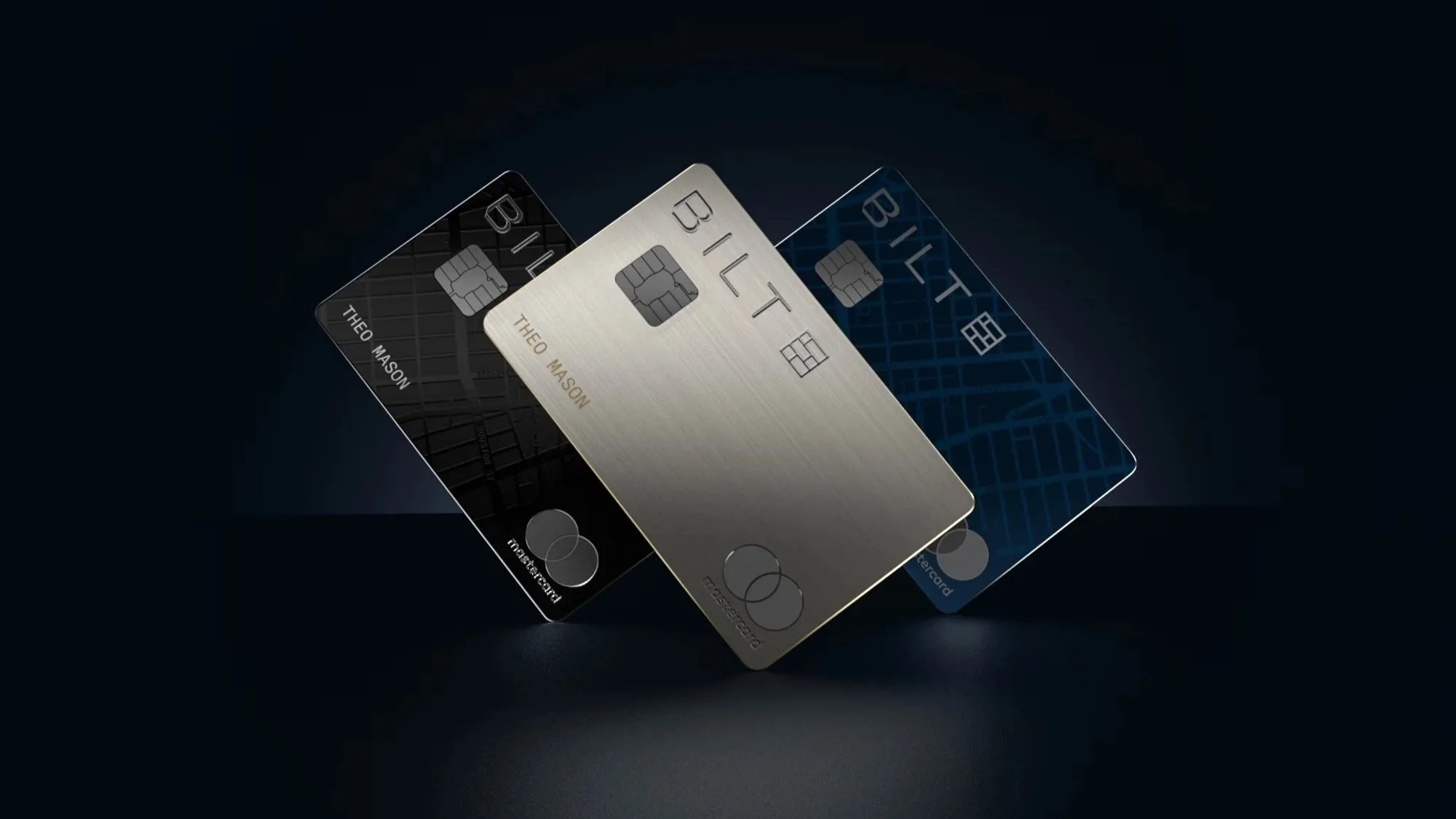
Bilt Blue Card (No Annual Fee)
Bonus:
$100 in Bilt Cash on account opening
Earning:
1X points on everyday spend
4% back in Bilt Cash on everyday spend
Benefits:
Concierge
No foreign transaction fees
Rental Car Insurance
Purchase Protection
Cell Phone Insurance
Bilt Obsidian Card ($95 annual fee)
Bonus:
$200 in Bilt Cash on account opening
Earning:
3X points on dining or grocery (grocery up to $25K/year)
2X on travel
1X on all other everyday spend
4% back in Bilt Cash on everyday spend
$100 in annual Bilt Travel Hotel credits ($50, twice per year, minimum two-night stay)
Benefits:
Concierge
No foreign transaction fees
Trip Delay Insurance
Baggage Insurance
Baggage Delay Insurance
Rental Car Insurance
Purchase Protection
Return Protection
Extended Warranty
Cell Phone Insurance
Travel Accident Insurance
Bilt Palladium Card ($495 annual fee)
Bonus:
50,000-point sign-up bonus + Gold Status (after qualifying spend)
$300 in Bilt Cash on account opening
Earning:
2X points on everyday spend
4% back in Bilt Cash on everyday spend
$200 in Bilt Cash
$400 Bilt Travel Hotel credits ($200, twice per year, minimum two-night stay)
Benefits:
Priority Pass (includes two guests)
Concierge
No foreign transaction fees
Trip Delay Insurance
Trip Cancellation/Interruption Insurance
Baggage Insurance
Baggage Delay Insurance
Rental Car Insurance
Purchase Protection
Price Drop Protection
Extended Warranty
Cell Phone Insurance
First Impressions
Given the editorial stance of LazyPoints, I’m obliged to be disappointed by the replacement of simple value (make 5 transactions to earn points on rent) with complication (points-earning on rent increasing with non-rent spending, and at a ratio that is difficult to understand intuitively). That said, at first glance I rate each of these cards as the best in their respective categories, and possibly the three best cards on the market.
Bilt Blue
I think many people will be disappointed that the Bilt Blue can’t replace the old Bilt Mastercard. You can’t just use it for a handful of purchases each month and collect a windfall of no-fee points. From that perspective, this card isn’t too valuable.
But if you just want a no-fee card, especially in a one-card wallet, this is an excellent option. The best no-fee cards, in my opinion, are those that earn 2% back on every purchase (like the Citi Double Cash) or those with 3%+ back on certain purchases (like the Wells Fargo Autograph card that the old Bilt cards will turn into, Amex Blue Cash Everyday, or Citi Custom Cash).
If Bilt Cash is worth dollar-for-dollar value, the Bilt Blue could deliver close to 5% back in value, or more. That’s better than the competition in even their best spending categories. If you choose to earn points on rent or mortgage payments, it could still earn more than double points, depending on how the math shakes out. And Bilt points are the most valuable rewards on the market, in my opinion. Plus, the card offers unusually generous benefits for a no-fee card, like concierge service, no foreign transaction fees, and rental car insurance.
Bilt Obsidian
Again, this card may suffer from comparison to its predecessor. But I would still rate it as the best ~$100 travel card on the market. Its earning rates and protections are at least comparable to the competition and the points are better, and that’s before you factor in the Bilt cash or points on housing.
To break even on the $95 annual fee, you will need to make a 2-night hotel booking in each half of the calendar year. That is inconvenient at best. But for me, if I had to choose among the options in this segment of the market, I would choose the Obsidian over:
The Citi Strata Elite (a $100 statement credit, but on portal bookings of $500+)
The Chase Sapphire Preferred (a single $50 hotel credit on portal bookings)
The Wells Fargo Autograph Journey (a $50 statement credit on an airline purchase)
The Capital One Venture Rewards (a $50 experience credit on “Lifestyle Collection” hotel bookings)
The Amex Green Card ($209 Clear+ credit)
Now, the Obsidian doesn’t offer any meaningful sign-up bonus (just a $200 Bilt Cash headstart), so most of the competitor cards offer far more first-year value as points injections. But on an ongoing basis, I think the Obsidian shines in this segment unless you regularly book $500+ hotel stays.
Bilt Palladium
Speaking of sign-up bonuses, though, Bilt’s first-year offer is extremely enticing. Although other cards in this space offer more points (with the Chase Sapphire Reserve and Amex Platinum recently offering up to 175k points in some channels), Bilt has never offered sign-up bonuses, and the chance to get 50,000 of them (my annual Japan trip requires 75,000) plus two years of Gold status (which has gotten me elite status with Alaska Airlines, Hilton, and Accor plus massive transfer bonuses in the past) is a very compelling offer.
As for the card itself, it’s like the Venture X—until now, my #1 rated credit card—but, I think, better. They both offer double points on base purchases, but Bilt’s points are more valuable. They both offer premium protections. They both offer Priority Pass lounge access. Capital One can offer its own (excellent) lounges, but the Palladium’s Priority Pass includes access for two guests, something that costs extra on the Venture X. The Venture X offers a $300 credit toward travel booked via its portal and $100+ in annual points to justify its $395 annual fee, while the Palladium offers two $200 hotel credits (2-night stay required) and $200 in Bilt cash against a $495 fee; the Capital One card fee and credit structure might be simpler, but you might come out further ahead with Bilt. Plus, Bilt offers potential points on housing.
One drawback of the card is that there are no bonus categories—it’s just double points on all purchases. If you spend a lot on categories that often have elevated bonus points, like dining, the Palladium would seem to have some opportunity cost. Of course, you can always pair the card with another that offers higher earning rates, like the Atmos Summit, Amex Gold (or the Wells Fargo Autograph—see below).
If Bilt Cash holds real value, though, I think the Palladium could easily justify being the go-to card in most spending situations—even dining out—and could be the best all-around credit card on the market.
Thoughts on choosing
My first thought is, despite my instant hot takes here, it would probably be worthwhile to wait a while to see what additional information might be forthcoming, especially about Bilt Cash. The points universe will be analyzing these cards closely, and the initial reactions might change with more time to digest. (My money says someone will find something fascinating deep in the terms and conditions.) Follow us on LazyPoints Weekly, our Sunday newsletter, as I’ll be sharing any new developments that come to light in our next two editions (the 18th and 25th) before the pre-order period ends on the 30th.
That said, I will almost certainly be choosing the Palladium. The hotel credits and Bilt Cash should come close enough to offsetting the annual fee to make it hard to resist 50,000 Bilt points plus two years of Bilt Gold status.
Also, while I initially planned to keep my Wells Fargo account and the Autograph card thanks to its 3x earning rate on multiple major spending categories and 1:2 transfer ratio to Choice hotels, I am leaning towards closing that account—I just think I would choose 2x Bilt Points plus 4% Bilt cash on the Palladium over 3x Wells Fargo points in almost every situation.
Lazy Take 🦥
The golden days of the original Bilt Mastercard are over, and Bilt 2.0 can no longer claim to be a pure lazy gem. But in a market crowded with complicated card setups, these cards still look like some of the most rewarding options available—and you can engage with them as simply or deeply as you choose.